Wednesday, June 10, 2009
Wednesday, May 27, 2009
Tuesday, May 26, 2009
Saturday, May 23, 2009
Re+Arts Update...
Marilyn Minter: glamour girl.
The reason I know it was only one semester was that I thought she was a horrible teacher, and I made sure to switch out when I had the chance. I thought she was way too self-absorbed and only interested in what fit into her seemingly narrow parameters of what could be considered art. My most vivid memory of her is a heated discussion she had with a classmate, where she flat-out tells him if he continues to make the paintings he did, he would never be shown in any real gallery.
Ouch.
I can't see her work without being reminded of that episode. And whether or not her work in this show was "real" enough for a "real" gallery, i have no clue. I still don't know what the hell that means. But whatever it means, it sure as hell is working for her. I don't know about the work, but she's incredibly successful. Her patented mix of high-gloss fashion with high-gloss irony heavily slathered in pervy sex POV close-up shots is the kind of shiny shit rich white people love to feel guilty about. I actually watch porn, which is why I don't tend to give much of her work a second glance.
Wednesday, May 6, 2009
How did I miss this one?!?

Sunday, May 3, 2009
Performanctallation
Saturday, April 25, 2009
Hangin' with the homies @ Pace
Friday, April 24, 2009
Wednesday, April 22, 2009
It ain't over!
Friday, April 10, 2009
"Painting, What It Became"
Well, OK. Everything makes sense so far "Painting, What It Became", a show of paintings.
Here were have a paintstallation (wall) and an installation (floor) I can accept the wall (hesitantly since in person it's completely a sculpture, it just so happens its a rectangle hung on a wall) But the TV with the mop on it? No. That is not a painting.
There's a painting! With two collages (acceptable as paintings) and a video, shown on a television... not a painting.
Voila! Two paintings... and a paintstallation (which is really a sculpture who's pedestal is the wall).Tuesday, April 7, 2009
The Art of Brotherhood
Friday, April 3, 2009
Wednesday, April 1, 2009
Pleasant thoughts about Amy Pleasant
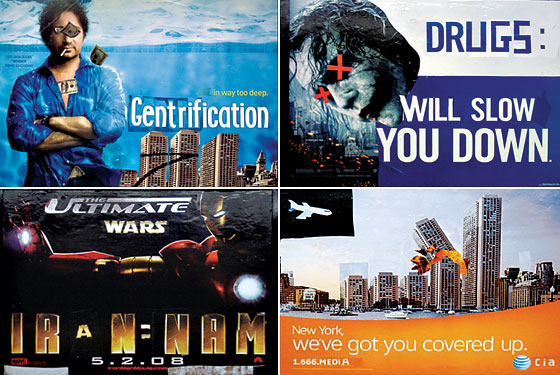
Poster Boys, or Poser Boys?
I don't know how many of you are aware of what's going on right now in the subways, but there's this guy "Poster Boy." "Poster Boy" is a 20 something guy who cuts subway posters and collages them back together in different arrangements to be witty social commentary. They're pretty damn cool, and though I've never seen one in person I always keep my eyes peeled in the hopes that someday something will subtly catch my eye and make me realize, "Holy shit, that's really not suppose to be like that."

Michael Anderson, on the other hand, began his career long before "Poster Boy", but I'm not convinced his work has the same power, or even the same potential for power that "Poster Boy's" work does. Here's why:
1."Poster Boy" takes pieces of the subway, and rearranges. He acknowledges with his work that advertisements really belong to the public. We are their purpose, so we always have the potential to alter it.
2. He honors the fact that the posters are meant for the dungeons, tunnels and piss scented rat caves and he leaves them there, all while re-defining and re-igniting an exploration of public art.
3. His work is performative. When people bare witness to an action it's much easier for them to imagine themselves doing it. (It is rumored that "Poster Boy" impersonators have been popping up all over)
4. Political commentary is meant for the masses, not for galleries. While Anderson's collages are undoubtedly beautiful, he's taking something meant for the masses and giving it to elitists.
5. Anderson showed up to the exhibition opening in a head to toe track suit, complete with cocked baseball cap. This may have been a nod to the "street" but lets face it, how many "Jenny from the blocks" really go to the Marlborough Gallery? It's that Post-modern irony seeping through again; track suits don't belong in galleries, just like subway posters don't.... but there they are.

© Michael Anderson
What I see in Anderson's work is beauty, composition, color, repetition, narrative, a homage to the great DADA artists, surrealist painters, and Picasso. As much as Anderson himself may see the work as being about "what it's like to be alive today," I think it's more of a statement about art its self. Anderson's work has very little to do with the actual ads. Sure, he rearranges them to make narratives, but they don't speak to subway/street culture. They are familiar, but I'm speaking to their familiarity as a lower middle class white female. I think perhaps Anderson's artist statement about the work being about life, suits "Poster Boy" more appropriately then it suits himself!
I've fallen in love with both of these artists. "Poster Boy" for bringing art to the subway, and Anderson for bringing the subway to art. The potential for great collaborations aside, I wonder what would happen if the two met. In some great world they'd get together for drinks at a bar and Anderson would talk all about how great it feels to be a sell out and "Poster Boy" would talk about the state of the states, and both would discuss how the people have the power, if only they knew how to get together to use it.
If you want to know more about Poster Boy here's a start:
http://www.nytimes.com/2009/02/04/arts/design/04post.html?_r=1&8dpc
http://www.nypress.com/blog-3216-poster-boy-ready-for-his-close-up.html
If you want to know more about Michael Anderson:
http://www.chamuconegro.com/
Sunday, March 29, 2009
My Neck Hurts
Richard Tuttle : Tuttle-Scapes
Friday, March 27, 2009
Thursday, March 26, 2009
Hey there, Frida Fans!!! (Or: Betty Crocker sucked!)
Dearest Natalie,
Julia Childs was without a doubt an innovator of the American culinary experience.
She pioneered the concept of a televised cooking show,
and with it introduced America to French cuisine, demystifying it for the masses, and in effect changing the cultural pallete forever, challenging and broadening the aesthetics of the average housewife in Idaho.
She achieved this though her passion for the art she loved: food.
But she was a mess in that kitchen.
I saw one show when she tried to cook a whole chicken in some recipe and she grabbed that bird and did things to it that looked illegal, immoral, and just plain ole wrong. Dan Akroid did a great skit as her in the first season of SNL, where (s)he gets a cut and bleeds all over the place and just keeps cooking.
She was clumbsy in that kitchen, to say the least, and that was the charm. It made her whole endeavor relatable. People saw themselves in that kitchen, thinking if she can do it...
She made the difference, not some array of skill or pastiche. She put her heart into the show and its message.
But her apples usually fell off her plate.
Wednesday, March 25, 2009
Saltz and Peppa
(Photo: Ellen Page Wilson. Image Copyright Rudolf Stingel and Courtesy of the Artist and Paula Cooper Gallery, New York.)She did. We did.

Still got hope, Obama

Da Prez, as he shall hence forth be referred as, is about to create a White House position responsible for the nation's Art and Culture, as per this article in the NY Times.
Definitely a step in some direction.
Not sure which.
I'm actually a little desensitized toward how the gov't feels about art.
Giuliani, Mapplethorpe, Serrano and Saatchi already fucked up my chance of getting anything directly from the NEA.
They (the gov) still haven't fully replaced the NEA funding they cut almost 15 years ago.
I'm just not plugged into that system enough.
I still think Art and Culture should be lumped in with Education. This way everyone would learn to be more comfortable with asking questions, instead of scared of someone taking gov't money and making porn.
Right back atcha "Painter!"
Frida was a good artist. Not a good painter. Period.
Thomas Kincaid is a good painter.
Georgia was an amazing painter (new york cityscapes? What are ya lookin at?)
DaVinci? Come on.
Dali? DALI?! Did u take shrooms before that video? Go the National Gallery at the Smithsonian and stand in front of the Sacrament of the Last Supper, and then repeatedly smack yourself in the head for even thinking that about my boy Sal.
Picasso was a prick. And a womanizer. And an amazing painter as well as the exemplary artist everyone blindly touts him to be.
And he loved Frida.
Tuesday, March 24, 2009
Louise Nevelson @ Pace 25th St

Louise Nevelson, Untitled (1968)
Photo by: Bill Jacobson / Courtesy PaceWildenstein, New York
Louise Nevelson
Like her. Love her obsessive tendencies. Love her impulse to unify the scraps of debris that surrounded her, and that she chose black as the color to create one from many, creating at the same time a jam-packed and clustered void.
Liked the showing of the work. Didn't like the sections of black walls behind some pieces (dramitic, overdramatic, mellodramatic?). Don't know how I feel about the placement of some pieces hung WAY high on the wall near the ceiling. Hurt my neck a little, and I don't know what it did to the space, other than stick out like a sore thumb.
And space, with its every subtle nuance, is Nevelson's medium of choice.
Frida can't paint.
It was at the most recent retrospective of her work at the Philadelphia Museum that I really started questioning things. I caught it on its last day and the show was packed, everyone with there audio tour headset clamoring for position near the next work the show's curators deemed important enough to talk about. And it was a bit of a pilgrimage for me. I've known Frida's work for so long and have yet to get tired of the blunt force trauma you can get from fully immersing yourself in her painful all-life-is-sorrow world. I've seen the majority of her paintings before in past exhibitions, back to the huge Latin American survey MOMA had in the early 90's, and the idea of seeing the "real" paintings was still important to me.
Until I saw them.
I was the overcome by the feeling that the actual paintings on the museum wall were not showing me any more than what I could see in the multitude of reproductions, artspeak for pictures of paintings, that have fed me for the majority of my life. In investing so much in the symbolic language that Frida called her own, and in the circumstances from where it came to be, I paradoxicly found myself distanced from the actual paintings themselves. And at that distance they began to seem crude and dry, as if the juice had been sqeezed and all that remained was the disgarded husk.
Now for my credentials: it's arguable that the work of Frida Kahlo was the prominent influence in myself becoming an artist, a.k.a. crazy and broke. Her work showed me the power of self-directed crazy at work; the exorcism of personal monsters that become inseparable from their host, exposing, owning, accepting, and ultimately using your monsters like a pimp whoring out his bitches.
Now, maturity has brought me the understanding that there was no redemption in her actions; as opposed to what that slop-filled melodramatic faux-biopic a few years back would lead you to believe. Those who knew her usually describe her as full of life, as a feisty spitfire, defiant in the face of all that befell her (and trust me, it was a lot).
But it all just adds up to the sad-clown syndrome for me. A brave face, elaborate costuming, a put-on bravada, all to conceal a lot of pain and fear that stayed with her all the way to her death; her last painting, a still-life where a watermelon half has the words "Viva la Vida" scrawled in its juicy pink flesh, has as much death as it does the life it so brazenly celebrates; the melon's pulp a clear reference to Frida's own vulnerable insides which was so often violated, both by accident and the frequent medical procedure. Being her last painting, its message has been taken as her epitaph, her motto that supported her through all her miseries. But I never felt comfortable with its inherent optimism. To Frida, life will go on a long time without her, and it will be filled with the same pain, and blood, and dead things that she knew intimately in her own. And it is this level of honesty that I have designated as the pinnacle of modern artistic achievement, for me anyway.
So, what the hell does all this have to do with Frida's painting ability? Well, nothing, and that's the point here. Frida Kahlo and the images she produced were so much more than the physicality of the work. It ultimately doesn't matter that the majority of her painting are flat and as visually predictable as a paint-by-numbers. Her greatest painting influences were Mexican retablo painters and her twice-married husband Diego Rivera, and her style combined the flat design-based visual architecture of Rivera's mural work with the awkward naiveté of the religious folk paintings. In both practices, paint is secondary. Frida used it to fill the spaces between what was going on in her psyche.
And that's ok with me.
In fact, it's possably the greatest testament to her work, to the world she created, where she cast herself as the tragic heroine whose sole purpose was to be subjected to all the sorrows that life can bring, and to endure. Nothing more.
It only took me almost 20 years to realize that the paintings themselve were only a supporting character in her play.
Friday, March 20, 2009
Re+Arts Takes on Ellsworth Kelly
Thursday, March 19, 2009
Taner Ceylan and the 5 Reasons Why I Leave Chelsea Wanting to Commit Suicide
A Glimmer of Hope in the Sea of Suck?
(for emphasis)
Chelsea's not dead yet, but it's getting tired and cold, it's blood
drained from it's already pasty white face.
I wanna thank Wall Street for being so incredibly selfish and fucking
up the whole system just when I'm about to graduate.
Oh, and painting isn't dead, it's just in a far-reaching state of
suck that I'm desperately trying to crawl my way out from under.
TTFN
(Tough titty, fuck nuts.)
Wednesday, March 18, 2009
Testing the water....
most of them kind of crappy.
Welcome to the new Artworld! Retarts!